Plot summary ❔
Pooh, after getting manhandled down the stairs in a slightly disturbing manner, he’s named protagonist by Christopher (who is not the villain of the story).
Pooh immediately proves himself to be a practical philosopher: he considers the Nature of the Bear, and also goes ahead trying to solve it (first by climbing a tree, then, ambitiously, by flying). Next, he shows off how asking for help really brings a community together, after showing how overstaying your welcome is the real proof you’re living in a civilisation. He also considers the nature of Plato’s Cave, and what we can really learn from tracks in the sand: surprising results ensue. Truly, “Optimus ursus mundi es”.
However, Pooh is not the only philosopher around – Eeyore teaches us to not stop with questions like “Cur?”, and instead expand to “quemadmodum?”, or even “haudquaquam huiusmodo?”, if you’re brave. Together, Pooh and Eeyore discover that philosophy is not sufficient if you’re not able to embody your philosophy, and explore practical philosophy and community management to allow Eeyore to heal. And, while he’s busy healing his friends, Pooh also helps Piglet with some exposure therapy when Piglet loses touch with reality and is trapped in dreams of large, aggressive fauna.
In the old discussion of effort vs results, Pooh comes down heavily on the side of effort, or rather, accepting any results produced by effort as lucky and productive – an outlook many managers could stand to learn from. Just look how unhappy Eeyore would be without it. Kanga, for example, has to be taught to let go and accept a certain measure of fortunate uncertainty when dealing with a growing child – and this time it is Piglet who is doing the teaching. Shout-outs to Pooh coming up with a new Dies Irae, just to assist in this lesson (see quotes). And, while he’s at it with the poetry, he also shows how a bit of beauty can support plenty of community interaction, if handled right (see also quotes).
In the final chapters, the story turns to darker issues: How to survive catastrophes of various kinds as a community. Starting with a horrible flood, they graduate to true horror: Saying goodbye to friends.
This book is, of course, adorable in every way. The dorky bear with his friends in various stages being excitable, exuberant, worried, forgetful, depressed, busy, or superior are delightful and a neat way to keep a child entertained.
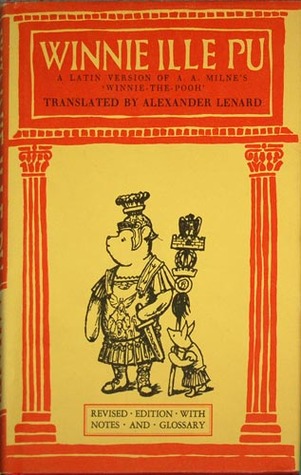
But clearly the best version of this book is the Latin version by Alexander Lenard (or at home: Lénárd Sándor), and that’s the one with the four-star rating. It follows the patterns and phrases of classical Latin to very comedic effect, and is probably best given to students in or past their fifth year of Latin.
It’s always nice to be reminded that the nerds have always been out there.
Fun Facts
Apparently, Lenard had a long-standing correspondence with Robert Graves in Latin – in character for both of them! For more of Robert Graves, see I, Claudius.